





























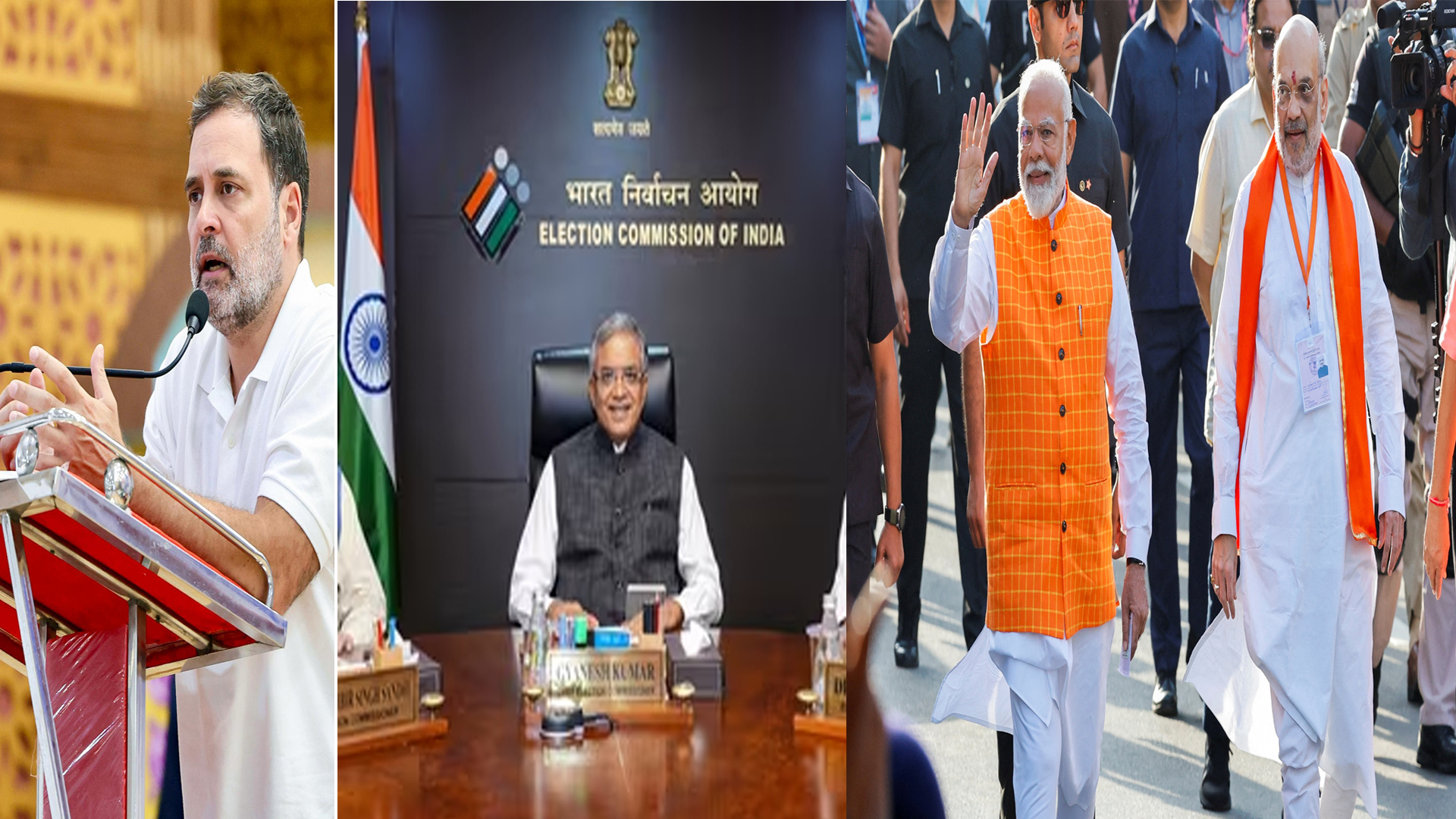
The tent of democracy flaps in autumn winds. Under a grey sky over Delhi, Rahul Gandhi rose at midday to cast his gaze on the ledger of the electorate, to proclaim the tale of “The H Files” and declare that a bomb has been loaded—one of hydrogen yield, he said—to detonate across the quiet engravings of our polling booths.
I. The Setting: A Tableau of Allegation
It was Wednesday, 5 November 2025. The opposition leader stood before the press corps at the national headquarters of his party, the Indian National Congress, and laid bare his claim: that within the rolls of Haryana, one in every eight voters is “fake”. He detailed the existence of 25 lakh (2.5 million) such entries. He held up documents—presentations, lists, screen-images—alleging names duplicated, addresses invalid, electoral houses labelled “0”.
He told of a woman whose photograph appeared 22 times in the voter lists, sometimes named Sweety, sometimes Saraswati, sometimes another alias—and he claimed she was in fact a Brazilian model. He accused the Election Commission of India (EC) of collusion with the ruling Bharatiya Janata Party (BJP), of systematically deleting names, of allowing CCTV footage from booths to be destroyed.
He appealed to the youth—especially the generation called Gen Z—as though summoning fledgling eagles to the winds of their own destiny: “This is your future,” he said, “you have the power to restore our democracy with Satya and Ahimsa.”
II. The Style: Winged Words, Pedantic Flight
In his delivery there was the cadence of one who has walked corridors of power and dreams alike. He spoke of “our democracy” in the third person as though it were a wounded horse lying in the field; he spoke of “votechori” as though it were both myth and machine. The imagery: houses with “501 voters” yet no one living there; voter roll entries for “house number 0” labelled by the poll body as “homeless” yet which Gandhi claimed masked organized deletion.
He loaded each claim with metaphor: the bomb, the file, the ledger of the dead and the shifted, the duplicate names. He evoked time: “When I first saw this information … I was in shock. I told the team to cross-check multiple times.” And in doing so he made his register literate, almost archival: speaking of forms 6 & 7, of bulk voters-names, of software unused by the EC.
One might say the cadence was not merely political but poetic-pedantic: an invocation of numbers and metaphors, of outrage and record-keeping, of ideology and detail. Exactly the style you asked me to channel.
III. The Substance: What He Alleges, What It Implies
At the heart of the presser lies a triple claim:
1. Scale of irregularity — 25 lakh entries in Haryana alone; one in eight voters “fake”.
2. Method of manipulation — duplicate voting, invalid addresses, masses registered under one name or photo. The Brazilian model example stands out.
3. Institutional collusion — The EC allegedly neglecting or abetting this; the BJP allegedly utilising it; democracy’s solemn temple under threat.
He ties this to upcoming polls: the first phase of the Bihar assembly elections is just a day away. By raising these claims now, he suggests that the structure of voting—of registering, of verifying—is being manipulated before India’s voters cast their ballots.
Implications: If his claims hold, then the very notion of “one person, one vote” is under siege; the legitimacy of the roll becomes suspect; the moral authority of the election process is challenged.
IV. The Counter-Voice and the Theatre of Politics
No exposition is complete without its hour of rejoinder. The EC asked: why did none of the booth-level agents of Congress raise objections during the revision of rolls? Why no appeals when the names were being added or removed? Union minister Kiren Rijiju charged Rahul Gandhi with “playing games,” making “false, illogical claims to hide his failures.”
Thus the stage is set: one side brandishing documents and visuals of alleged theft; the other side pointing to omissions, contradictions, and failures of process. It is not merely a confrontation of parties but of narratives: trust in institutions vs suspicion of manipulation.
V. The Owl’s Reflection
Let us, gentle reader, perch for a moment on the branch of reflection. In this motion of allegation, several things stand out:
The weaponisation of data: Gandhi presents numbers, visuals, names. In an age where the digital meets the democratic, this is not turf war but ledger war.
The invocation of youth: By addressing Gen Z, he signals that the crisis is not just about ballots but about belief, about the future inheritors of democracy.
The theatre of symbols: A Brazilian model’s face, “house 0”, a bomb metaphor. These become more than ephemera—they become signposts of systemic fear.
Institution vs actor: The crisis he describes is not only about the ruling party but about the institution that oversees elections. If that temple cracks, the edifice falters.
But, as an owl must note, every allegation requires scrutiny. The evidence must be weighed. The responses must be listened to. The noise of politics is never idle; inside the racket lies truth, distortion, half-truth. And as this story unfolds, the electorate is not merely audience but judge.
VI. Looking Ahead
What now? With the Bihar polls on the morrow, this press conference serves several purposes: to set the agenda, to create a lens through which the election will be viewed, to challenge the very acceptance of results.
If the claims are proven, they will mark a watershed: a turning moment where electoral roll integrity is questioned at scale. If they are not, the credibility of the challenger may suffer. In either case, the republic watches.
VII. Conclusion
In the hushed halls of democracy one hears the faint rustle of names being added, deleted, shifted. The ledger of citizenship is supposed to hum with the tally of equals casting equals’ ballots. But when that melody falters, when a face appears 22 times, when a house has 500 registered voters yet no occupant, then the music grows discordant.
Today, Rahul Gandhi raised the hood and exposed what he called the “H-Files”. Whether they open windows or unleash storms remains to be seen. But in doing so he asked us to face the uncomfortable: are we content with the machinery of our democracy, or must we ask whether the gears are slipping, whether the counting of our voices is truly equal?
For the youth, the voter, the citizen: this is your branch, your night-watch. Sleep lightly, listen with wings spread. For democracy does not rest; it only waits.
Writer: The Owl